

Digital transformation always sounds clear in an RFP or slide deck, but in practice things can get fuzzy fast. What exactly are we transforming? Is this about customers, or about ourselves? Are we reshaping workflows, or the entire business model? Without answers to these questions, projects stall, swirl, or never quite get started in the first place.
As a Certified Sense-MakerTM and fuzziness connoisseur, I love helping clients make sense of their digital transformation initiatives.* This includes helping them understand the bigger picture, what their plans will mean for business operations, and what tools or solutions can help. By implementing short, structured strategy and shaping phases, organizations can gain shared clarity and overcome transformational fuzziness.
* Just kidding: there isn’t a Sense-Maker(tm) certification. (Sigh.)
Fuzziness Factor #1: The Big Picture
Digital transformation initiatives are typically triggered by something bigger: business model shifts or expansions, operational maturation, rebrands or relaunches. And these initiatives go far beyond technology upgrades. There is a very real shift in culture, a move towards a product mindset, and an optimization of processes that meet the demands of the market. When done well, these initiatives have a lasting impact on the organization and the benefits show up on the bottom line.
But teams that are at the “ground level” of this transformative work often have a fuzzy understanding of the macro-strategy and how the immediate near-term effort fits in.
Take a Fortune 500 media company I worked with. They had debated for a year whether to introduce self-serve sales alongside their high-touch direct sales model. Nothing with the project had moved because no one had named the real issue: This wasn’t just a sales project — it was a business model transformation. Misalignment across stakeholders was causing them to delay decisions.
Once reframed as a fundamental cultural and business model shift, two things became clear:
- Ownership: Leadership had to sign off on the experiment and assign a real owner. Until then, no team felt they could start it.
- Constraints: A full model shift would be a multimillion-dollar, multi-year play. But the first step could be much smaller: A controlled pilot for a narrow customer segment in one slice of the product portfolio.
I saw the same dynamic with a pre-IPO health care client. Leadership was shifting from concierge medicine to value-based care and wanted to build operations software for a new care management team. But they hadn’t explained the macro-level change to the engineers, who were understandably confused: What does this have to do with our existing product? I ended up at their product engineering offsite — not to talk code, but to explain the business model shift and how it reframed the software we were building. With that clarity, the team could finally design and build the new care operations platform.
Lesson: If the macro-strategy is fuzzy to individual contributors, the whole project is fuzzy. Clarify the big picture first.
Fuzziness Factor #2: Messy Operations
Many organizations struggle with their digital transformation initiatives as they confront the messy reality of business operations:
- Coordinating across multiple teams: In the previous self-serve sales example, the pilot program touched workflows across six operations teams and three systems, all of which had a fuzzy understanding of the others. I spent several weeks facilitating discovery sessions, creating canonical process maps, and translating nomenclature inconsistencies. Without that clarity, it was difficult to see what exactly needed to change across existing processes and systems for the pilot to succeed.
- Initiatives must match real-world operations: A grantmaking foundation I worked with wanted to include their new “Helps” program in the revamped operations software we were designing. I said, “Great, tell me about the Helps program and process.” They said, “Weeellll…we haven’t actually figured that out yet.” We had to help them define the real-world workflows before we could figure out the software workflows.
- Success requires a purposeful change management strategy: A current client took an “if-you-build-it-they-will-come” approach to their operations software revamp, and internal users stayed away. The client belatedly realized that operations transformation projects need more than successful design and build: They need purposeful change management, like an internal Go-to-Market strategy.
Lesson: Internal transformation is never just a tech build. It’s a business operations change, with all of the real-world people and process messiness that comes with it.
Fuzziness Factor #3: Solutioning
Even when the strategy is clear, determining the right solution for the problem can get fuzzy.
- Internal tools vs. customer-facing products: For operations transformations, discovery and roadmapping can look very different for internal tools than for customer-facing products. Because multiple teams and systems are typically involved, there’s inevitably a ton of internal discussion, translation, and even negotiation before reaching shared clarity about what we’re doing. These initiatives need folks who understand how to navigate this unique discovery context to iron out the fuzziness.
- The “parity” problem: Another common fuzziness pitfall is the idea of “parity” in system rebuilds. Rebuilds usually have an inherent contradiction: Clients want to rebuild to notional feature parity (“We can’t lose what we already have!”), but the whole reason they’re rebuilding is because the existing system is unsalvageably flawed in multiple ways. (“Ugh, please don’t literally rebuild the current state because it’s a mess!”) It’s rarely clear what should be rebuilt exactly as-is; which outdated, unnecessary features can be deprecated; or which wonky UX to rethink entirely. In one engagement, we introduced a “parity meter” concept to help the client differentiate between areas we would design and rebuild with more literal parity vs. areas we’d do more rethinking.
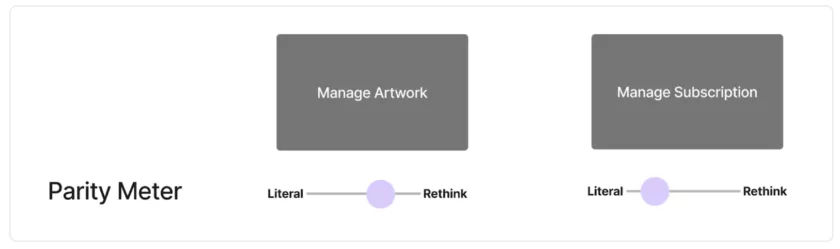
- The importance of discovery before transformation: At the other extreme, leaders may lock onto a specific solution too soon. With a bit of structured strategy and shaping, we can test those assumptions and often find a better path. As a recent client said after a transformation strategy engagement:
“One of the greatest things you did to help us was to redefine root problems that we had mischaracterized. There were two or three paradigm shifts that, as we thought through it more, we realized our mental model about the problem/solution was wrong, and until that changed we’d always solve it the wrong way. Having external people work through it with you is one of the only ways you can make that mental shift and get to that clarity.”
Lesson: It takes a nuanced understanding of digital transformation’s unique context to get past solutioning fuzziness (or misguided clarity).
Strategy and Shaping: The Path to Shared Clarity
To mitigate all of the potential fuzziness, we start transformation projects with structured strategy and shaping phases. These phases aren’t head-in-the-clouds, million-dollar consulting boondoggles. They’re short, tactical efforts — typically weeks to a few months depending on organizational scope and complexity — that:
- Clarify the larger strategic initiative and how this effort fits in.
- Reframe internal tools as operations and change-management efforts.
- Surface operational realities and user needs by engaging subject matter experts (SMEs) and internal users.
- Define the high-level solution shape and roadmap, including foundational UX/UI strategy, features, and architecture and technical specifications.
- Allow for dev spikes and other technical risk mitigation, along with vision design prototypes for early validation.
- Align multiple teams and stakeholders on a shared vision.
- Create space for co-creation, feedback, and buy-in.
- Provide the just-right level of clarity to start full design and dev sprints, without falling into waterfall overdefinition.
Moving Your Digital Transformation Initiatives Forward
If you’re starting a digital transformation initiative and feeling the fuzziness, know that this is a normal, but critical, moment. That feeling isn't a sign of failure; it's a signal to pause and figure out how to find shared clarity. By deliberately addressing the big picture, the operational mess, and the solution itself, you can set your project up for success. It’s not about avoiding the fuzziness, but knowing how to work through it — and when to call a Certified Sense-Maker(tm) for help.
In summary, we can classify these common challenges and opportunities into three categories:
- Big Picture Fuzziness: Not clarifying whether the initiative is incremental improvement vs. a true business model shift.
- Operational Fuzziness: Failing to approach the initiative as an operations change with plenty of real-world messiness.
- Solution Fuzziness: Applying the wrong lens to solutioning, such as taking an overly blunt approach to rebuild parity.
If your organization needs help moving your transformation initiatives forward, let us know. Together, we can work past the fuzziness and develop a strategy for success.