
If the same reasoning path writes the system change and defines the proof of success, you may be setting yourself up for an avoidable failure in the future. Harness engineering is meant to act as an extension of your own organizational guardrails, which were always meant to reduce risk and improve quality.
Travis Frisinger, Head of Agentic AI
Your team is shipping more AI-written code every quarter. How do you know it is any good?
Good means it meets your standards, and you have probably already tried handing your agents the standards: a context file, a style guide, the wiki pasted into the prompt. The agent reads them, agrees, and still breaks them, because instructions to a model are suggestions. What the repository permits is what actually happens. Your people absorb standards through review comments and hallway corrections, and the lessons stick. An agent apologizes and forgets by the next session. The only place its lessons can accumulate is the repository itself.
That gap used to be an annoyance. With AI doing real engineering work, the quality gap is the whole game.
Harness engineering is the discipline that closes it. It is the process of imbuing a repository with your standards so that the repository itself enforces them: permissions and boundaries that say what any actor may touch, quality gates that fail closed, evidence attached to every change, and observability that spans runs rather than moments.
Models supply software delivery capacity. The harness supplies observable accountability: every change carries what was done, which rule allowed it, and what happened as a result, no matter which model, agent, or person did the work.
Why now
The industry started using the term harness engineering back in February, 2026. Since then, Thoughtworks, LangChain, and others have built serious thought leadership around the same shape. When several firms independently converge on the same word, it usually means they are trying to name the same problem.
The real problem is this: AI pilots demo brilliantly and then stall on the way to production. Not because code generation is weak; that stopped being the bottleneck some time ago. The bottleneck is verification.
An agent can produce a plausible change faster than your team can decide whether to trust it, and a backlog of plausible-but-unverified changes is not velocity. It is inventory and technical debt waiting to break something in the middle of the night.
This is not just the stuff of software wonks and conference talks. Engineers are publicly building personal software factories: agent loops that pick up issues, write code, validate it, and report back overnight. Enterprises like Ramp, Stripe, and DoorDash have built their own internal versions to drive business outcomes and efficiency, and vendors now sell the platform outright off-the-shelf. Some of your engineers are probably running one right now in production.
Building the harness the factory will run on is becoming table stakes to delivering agentic workflows at enterprise scale. You can buy the model access. You cannot buy the harness, because the harness is your own standards made enforceable in your own repositories. That is where the trust comes from, and no vendor ships it in the box.
There is a maturity arc in how engineering teams hand work to AI:
- Assisted. The model suggests. A person asks, reads the code, and decides what ships.
- Harnessed. The system executes multi-step work under gates. A person reviews the evidence and approves the outcome.
- Risk-tiered. The gates grade the risk. Low-risk changes merge on their own, and a person reviews intent only where the risk says so.
- Autonomous. Work enters, and the harness executes and validates it. Humans govern the boundaries, inspect the evidence, and intervene when the system falls outside them.
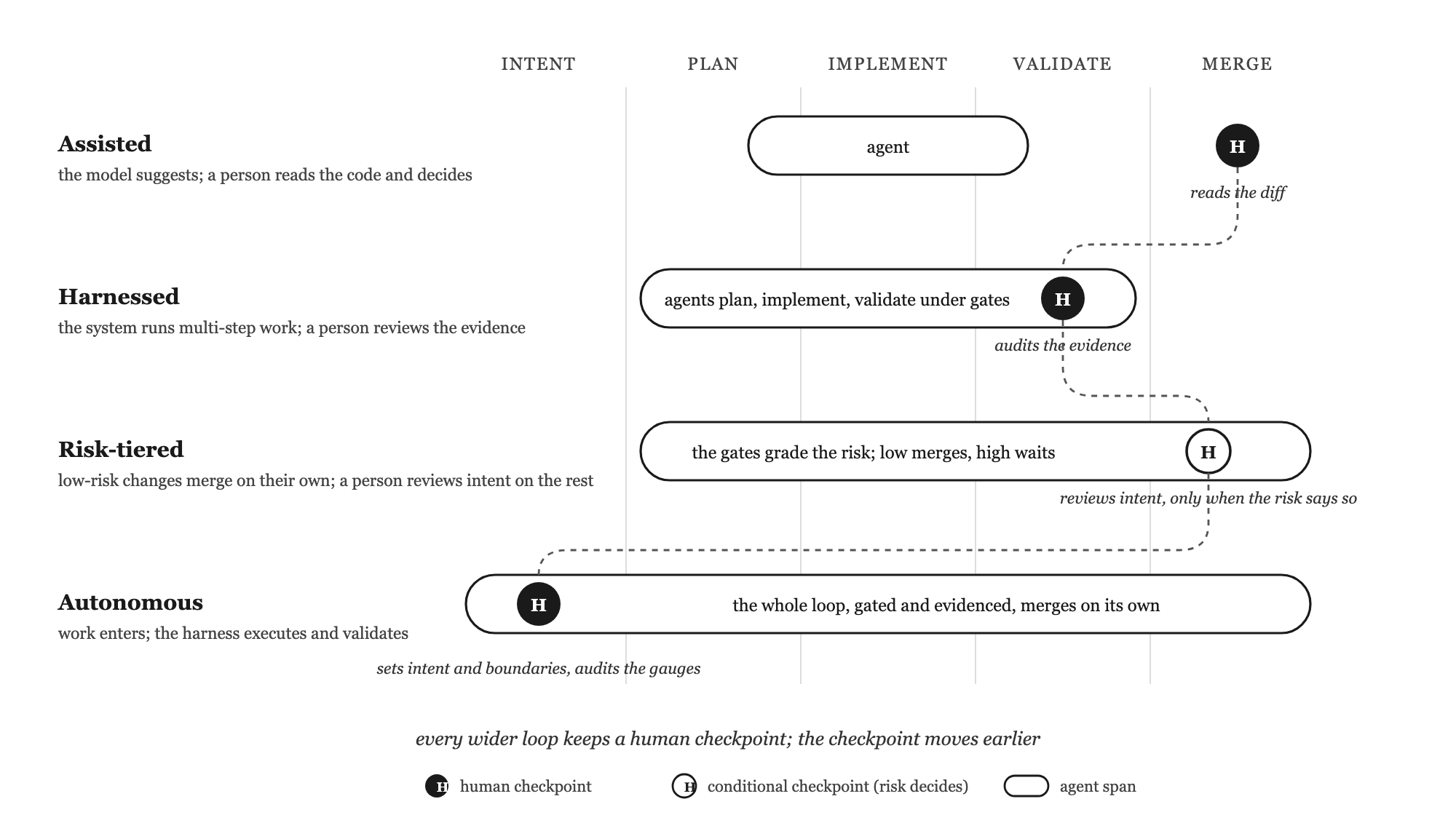
Figure 1. Every wider loop keeps a human checkpoint. The checkpoint moves earlier: from the diff, to the evidence, to intent on the risky cases only, to the boundaries.
Notice what stays consistent: the human is never removed from the broader workflow. The human role moves upward, and it becomes conditional before it leaves any one loop for a wider one. At the same time, more of the review, challenge, and reflection can itself become governed machine work.
Harness engineering is what makes each step toward greater autonomy safe to take.
What it looks like when it is real
Three patterns show up in every serious implementation I have seen or built on client engagements. None of these patterns require exotic machinery: everything is built from parts your repository host already has. A required check that blocks a merge is a gate, and every repository host already has one. The parts do not change as a team matures. What changes is how many of them are required.
Gates that fail closed. At its simplest, a gate is simply a required check: a change that cannot produce its evidence does not merge. That holds for a senior engineer having a confident day, and it holds for an agent that produced something plausible at 3 a.m. As the harness matures, even the gate reader stops being trusted: my factory's merge step asks the host which required checks passed, and an error in that probe counts as a failure.
When the infrastructure itself has a problem, the answer is stop, not shrug: the same system, hitting a spend limit mid-run, stops the day's work rather than degrade quietly, and a budget-stopped day cannot restart itself through retries. Silent degradation is how trust dies and how budgets are quickly exceeded.
Evidence as the working currency. In a harnessed repository, every merged change adds its own verdict to the ledger: what was checked, by what, and with what result. A mature harness adds provenance: my factory appends a reproducibility manifest to the pull request, the models, prompts, and configuration in effect at authoring time, so that months later when a root cause analysis asks "what produced this change?", the record answers on its own.
The review process stops meaning reading every diff and starts meaning auditing verdicts and sampling deeply where the evidence looks thin on the surface. That is not a lowering of the quality bar or sweeping reviews under the rug. It is the same quality bar, held at a higher altitude where humans operate day-to-day.
One caution that the measurements insist on: if the same reasoning path writes the change and defines the proof, you may only have one opinion wearing two hats. Verification needs a reviewer whose charge, evidence, or objective is independent of the author's. Model diversity is one more lever. A judge running on a different model family does not share the author model's blind spots, so the two are less likely to fail in the same way.
The old disciplines, compiled. The practices your best teams spent twenty years internalizing move from being embedded culture to configuration templates. Every project leads with tests first, small diffs, executable acceptance criteria and traceable changes. In my factory, 'test before commit' is written law, a hook blocks any agent from claiming done while a test fails, and branch protection is a versioned ruleset, not a static and outdated wiki page at the repo level.
Where this goes: the repo becomes a mini-organization
Here is the part that surprised me, and the reason harness engineering deserves an executive's attention, not just an architect's.
It did not show up in the first weeks. It showed up months in, once I understood the operator's seat: the person who runs the factory rather than working inside it. Early on I was directing the code, one instruction and one diff at a time. Somewhere along the way I began directing the system instead. I set the intent, the boundaries, and the conditions for acceptable work. The factory handled the execution and left evidence behind. What that evidence taught me changed what I asked for next. Over time, the factory began organizing those expectations into its own structure, separating how work should be done from what the resulting software had to be. I had not designed that structure in advance. It emerged before I even had a name for it.
There is an old law in this business of software engineering: software ends up shaped like the organization that builds it. A harnessed code repository runs Conway's Law in reverse. Wire enough standards, evidence, and judgment into a repository, and an organization starts taking shape inside the software.
Once your standards are executable, the repository can hold agent-based roles filling specific seats, not just generic scripts. And those seats can cover diverse responsibilities and working styles: a product seat that grooms intent into well-formed work, a quality review seat that judges changes with named charges of failure. For instance: one attacks feasibility, one attacks security, one attacks the user's experience. These are fully auditable decision records that nobody, human or machine, can skip. Once implemented, immutable ledgers can track whether each reviewer's findings survive scrutiny, so the judges themselves get calibrated over time based on your risk tolerance and working style.
These role-based seats convert to autonomous agents only when their output can be verified mechanically; where complex judgment is the verification, the seat remains a human one.
This is not speculation. In our research system, HydraFlow, repositories now convene review councils before designs land, file dissent by name, and keep calibration records on their own judges.
Humans did not disappear in this modern world of agentic software development. Their role moved up: setting and ratifying direction, defining authority, and auditing the institution, while the system increasingly participates in those same processes under articles that govern how change becomes legitimate.
A production-grade repository run this way stops resembling a codebase with bolt-on automation tooling and starts resembling something else entirely.
A framework for governing it
I wrote recently on my own blog about what six months of running a personal software factory taught me, What Matters After the Software Factory Works. The lessons eventually compressed to four words:
Purpose is what the work is for. Articles define what must remain true. Actors do the work under delegated authority. Artifacts preserve what the organization produces and remembers.
PAAA, for short, describes a simple and repeatable framework for governance.
Every established engineering organization has some version of these oversight structures. As engineering systems become more autonomous, the same structures increasingly need to exist inside the repository.
The harness makes the Articles executable. People and agents staff the Actors. Evidence, decision records, ledgers, and institutional memory become the Artifacts. Intent supplies the Purpose.
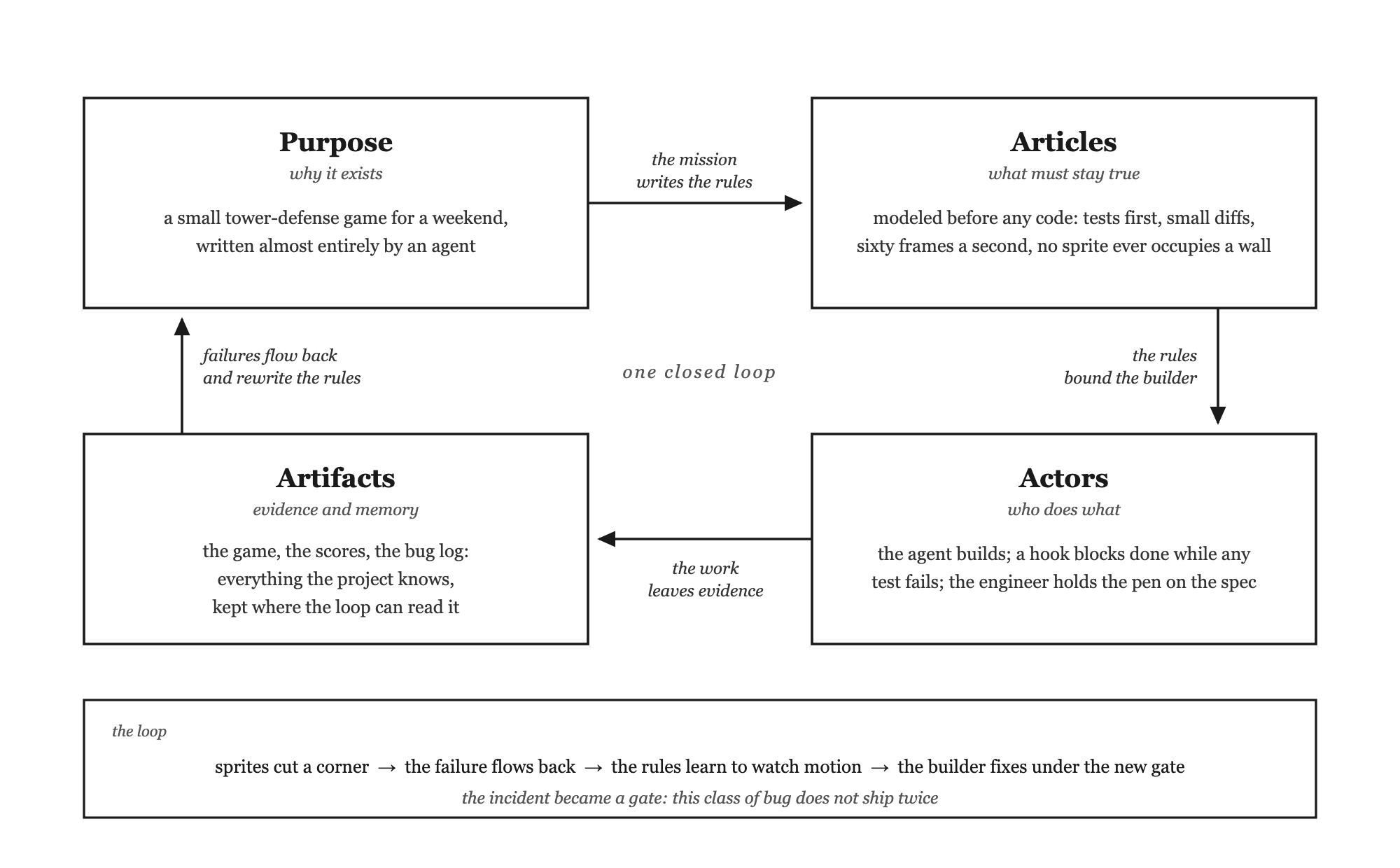
Figure 2. The four words at weekend scale. The mission writes the rules, the rules bound the builder, the work leaves evidence, and failures flow back and rewrite the rules. One closed loop, even in a test project.
This is the larger cultural implication of harness engineering. Once a repository contains not just workflows, but authority, boundaries, evidence, memory, and mechanisms for changing its own rules, it begins to resemble the organization operating through it.
Humans do not disappear from that harness engineering-guided organization. They define its purpose, grant authority, ratify its deepest rules, and audit whether the system continues to behave as intended.
What you are building when you invest in a harness is not a smarter pipeline. It is a development organization in a box, and it reports to you.
Where to start
The four framework words double as an audit your leadership team can run this quarter.
These four questions are the agenda of our half-day harness engineering working session. We run it with your engineering leaders, in your context and against your own repositories, and you leave the same day with a written answer to each question and a path forward.
Ask yourself the following questions:
- Who sets the direction for your AI initiatives, and what happens when that direction goes silent?
- What must always remain true across your repositories and workflows, and what enforces those rules when nobody is looking?
- Who, or what, holds each decision role in your review process, and how would you know if a role went rogue?
- What do your systems remember, and where does that memory live?